What Does a Top-of-the-Line FleetMaster6-NG CDL Simulator Look Like?
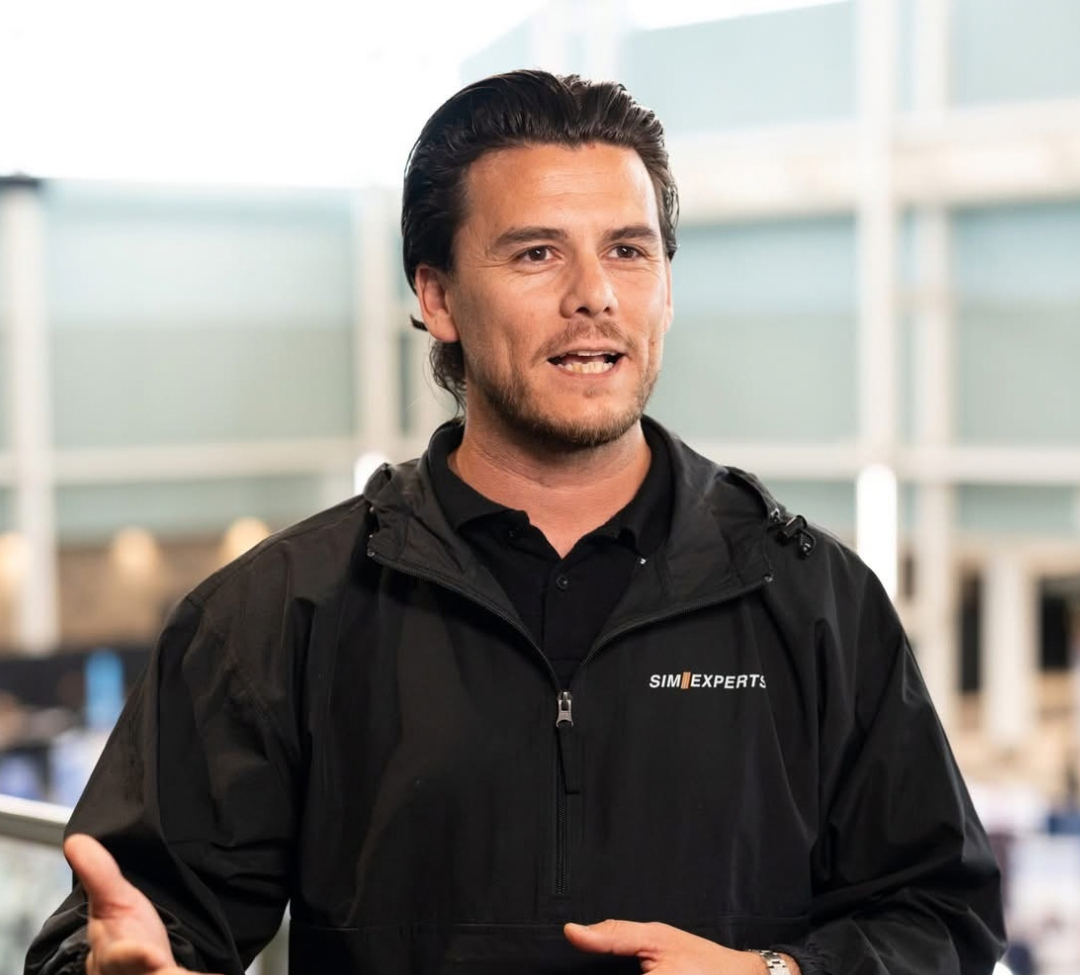
Last week, the Sim Experts team and I traveled to Jackson, Tennessee. It’s the home of our newest client, the Tennessee College of Applied Technology, to support the grand opening of their new Transportation and Logistics facility and the next chapter of their Driver Training program.
While I was there, I had an opportunity to spend a few minutes on camera talking about the FleetMaster6-NG. For anyone interested in what the pinnacle of high-fidelity commercial driving simulation can look like, this is an impressive piece of equipment and about as close as it gets to bringing the cab of a commercial vehicle into a training environment.
The FleetMaster6-NG sits at the top of the standard commercial driving simulator lineup from Advanced Training Systems (ATS). To be clear, both smaller and larger more specialized simulation systems exist. Though, when you consider capability alongside the realities of deployment, such as space, infrastructure, power requirements, user-friendliness and budget, the FleetMaster6-NG represents something of a sweet spot: a flagship system capable of supporting a broad range of CDL training objectives while still being practical for a school or training facility.
Much of that approach starts with the hardware. As you can see in the video, the driver’s experience is built around OEM-style equipment. A Freightliner Cascadia in this instance, though the ATS team also offers Kenworth and other model options. That goes well beyond the appearance of the dashboard. The steering column, turn signals, switches, gauges, pedals and other controls are positioned and operated as they would be in the cab.
There’s value in that one-to-one relationship, because when a student experiences feedback, reaches for a control or looks toward a gauge the objective isn’t to approximate where it might be in a truck. It’s there, where you’d expect it to be. Functioning as they expect it to function. Down to the puff of air coming from the range selector and the grinding of gears on their patented transmission.
Surrounding the driver is a dome-style enclosure providing the driver with a 270º field of view. That becomes especially useful during space-management and backing exercises, where the driver can use the mirrors and surrounding visual environment to understand the location and movement of the vehicle.
Underneath it all is ATS’ motion and training technology. The motion system adds physical feedback to what the driver sees and does, while ATS’ learning modules help the driver develop skills through exercises such as shifting, double-clutching, backing and vehicle control. Together, the controls, visuals, motion and structured exercises help create that important “suspension of disbelief,” an industry term we use that relates to the driver’s mind “accepting and believing” that what they are experiencing is real. This, in turn, translates to a greater level of training and understanding, and also greatly mitigates the sensation of simulator sickness (“SAS”) drivers sometimes experience.
As shown in the video, that experience also extends outside the simulator. Two 4K displays allow instructors and other students to observe the driver’s perspective, vehicle condition and external views of the simulated vehicle. Simulation doesn’t have to be a one-person experience. Students can watch one another, discuss what went right, identify what went wrong and learn from the person in the seat. From a training perspective this is what I think is one of the most valuable aspects, and one I have yet to see other manufacturers provide; The ability to debrief, learn and improve in a safe and controlled environment.
But realism alone doesn’t necessarily make a simulator a better training tool. There are different approaches to simulation because there are different training objectives. Sometimes the priority is accessibility, repetition and throughput. Giving entry-level students more opportunities to practice fundamentals. Other times, the objective is maximum immersion and fidelity. Recreating the vehicle, its behavior and the driving environment as closely as practical. The FleetMaster6-NG is an excellent example of that second approach.
At Sim Experts, we work across that spectrum. From compact classroom trainers to full-scale platforms like that featured in the video. The question isn’t simply, “Which simulator is best?” It’s, “What are we trying to teach, and which tool best supports both the trainer and trainee in that objective?”
For programs looking toward the high-fidelity end of that spectrum and asking what the “top of the line” model of a practical, deployable CDL simulator looks like—the FleetMaster6-NG at TCAT Jackson is a great example.
Congratulations to the team at TCAT-Jackson on the launch of their new facility and program. We’re proud to have them as the newest Sim Experts client and excited to see this system coach, train and build the next generation of professional drivers.
Until next time—over and out,
Enrique Allen Mar
Principal I Founder
Comments